 Ukrainian
 Polish
 Slovak
 Czech
Czech Romanian
 Irish
Irish Hungarian
 Russian
 Hindi
Hindi Portuguese

Common Newborn Ailments
During the first weeks and months of your baby’s life, you may notice changes in their skin, digestion and behaviour. Conditions such as nappy rash, cradle cap and colic are very common and are usually not serious.
Knowing what to expect, how to care for your baby at home and when to seek medical advice can help you feel more confident.
Nappy Rash
Nappy rash is a red, sore, moist or sometimes broken area of skin around your baby’s bottom and nappy area. Most babies develop nappy rash at some stage, although some have more sensitive skin than others.
What Causes Nappy Rash?
Nappy rash can develop when your baby’s skin is in contact with urine or stools for too long. It may also be caused or made worse by:
• A wet or dirty nappy.
• Friction from a tight-fitting nappy.
• Sensitive skin.
• Diarrhoea or frequent bowel movements.
• Certain soaps, wipes, lotions or fragranced products.
• Antibiotic use.
• A fungal infection such as thrush.
Your baby may also be more likely to develop a sore bottom when they are teething.
Signs of Nappy Rash
Your baby’s skin may appear:
• Red or inflamed.
• Shiny or moist.
• Spotty.
• Dry, cracked or broken.
• Sore when touched or cleaned.
Your baby may seem uncomfortable or become upset during a nappy change.
Caring for Nappy Rash
To help the skin recover:
• Change wet or dirty nappies as soon as possible.
• Wash your hands before and after each nappy change.
• Clean your baby’s skin gently using cotton wool and water.
• Pat the skin dry rather than rubbing it.
• Leave your baby’s nappy off for short periods to allow air to reach the skin.
• Make sure the nappy is not fastened too tightly.
• Apply a thin layer of a suitable barrier cream if needed.
Changing your baby regularly and giving them some nappy-free time can help prevent and soothe nappy rash. Young babies may need their nappies changed up to 12 times a day.
Try to avoid fragranced soaps, bubble baths, talcum powder and heavily perfumed skincare products on your baby’s nappy area. Read product labels and choose mild, fragrance-free and hypoallergenic products where possible.
When to Contact Your GP or Public Health Nurse
Contact your GP, pharmacist or public health nurse if:
• The rash is not improving after a few days.
• It is spreading beyond the nappy area.
• The skin is badly broken, blistered, bleeding or oozing.
• Your baby has spots or blisters.
• Your baby appears to be in significant pain.
• Your baby has a fever or seems unwell.
• You think the rash may be caused by thrush or another infection.
Your GP may recommend an antifungal or other medicated cream if the rash is caused by an infection. Do not use a steroid, antifungal or medicated cream on a newborn unless advised by a healthcare professional.
Jaundice
Jaundice is common in newborn babies during the first week of life. It causes your baby’s skin and the whites of their eyes to look yellow. Mild jaundice often settles on its own as your baby’s liver matures.
Contact your midwife, public health nurse or GP if your baby’s jaundice appears to be getting worse, spreads to their arms or legs, your baby is difficult to wake, feeds poorly or seems unusually sleepy. Babies are routinely checked for jaundice after birth and during the early postnatal period.
________________________________________
Sticky or Watery Eyes
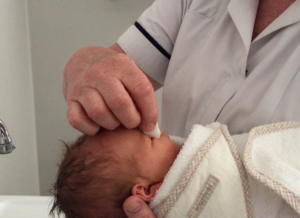
Many newborn babies develop sticky or watery eyes because their tear ducts are still developing. This is usually harmless and often improves by itself during the first few months.
Gently clean your baby’s eye using cotton wool or gauze soaked in cooled, boiled water, wiping from the inner corner outwards. Use a fresh piece of cotton wool for each wipe and each eye.
Contact your GP if the eye becomes very red, swollen, produces yellow or green discharge, or if your baby seems uncomfortable.
________________________________________
Oral Thrush
Oral thrush is a common fungal infection in young babies. It appears as white or creamy patches inside the mouth that do not wipe away easily. Some babies may become unsettled during feeds or feed less well.
If you think your baby has oral thrush, contact your GP or public health nurse. Treatment may be needed for your baby and, if you are breastfeeding, for you as well to prevent the infection passing back and forth.
________________________________________
Baby Acne and Common Newborn Rashes
Many newborn babies develop harmless skin rashes during the first few weeks of life. Baby acne appears as small red or white spots, usually on the cheeks, nose or forehead. Other newborn rashes are also common and usually disappear without treatment.
Wash your baby’s skin with plain water and avoid creams or acne treatments unless advised by a healthcare professional.
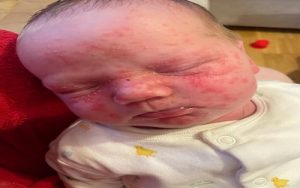
Seek medical advice if your baby develops a rash with a fever, appears unwell, has blisters, or if the rash does not fade when pressed with a glass.
________________________________________
Reflux and Posseting
It is normal for babies to bring up small amounts of milk after feeds. This is known as posseting and is common because the muscle at the top of the stomach is still developing.
Holding your baby upright for a short time after feeds, winding them regularly and avoiding overfeeding may help.
Contact your GP if your baby is vomiting forcefully, vomits green or blood-stained fluid, is not gaining weight, refuses feeds or seems distressed during or after feeding.
________________________________________
Constipation
Some babies pass stools several times a day, while others may only go every few days. Breastfed babies can sometimes go several days without a bowel movement and still be perfectly healthy.
Constipation is more likely if your baby passes hard, dry stools, seems uncomfortable or strains without producing a stool.
Speak to your GP or public health nurse if you are concerned that your baby is constipated. Do not give laxatives or change your baby’s formula unless advised by a healthcare professional.
________________________________________
Blocked Nose and Newborn Snuffles
Newborn babies often have noisy breathing or a blocked nose because their nasal passages are very small. This is sometimes called “newborn snuffles” and usually settles on its own.
Keeping your baby upright after feeds and ensuring the room is free from cigarette smoke can help. If needed, sterile saline nasal drops may help loosen mucus before feeds.
Seek medical advice if your baby has difficulty breathing, is struggling to feed because of a blocked nose, develops a fever or seems generally unwell.
________________________________________
Umbilical Cord Care
Your baby’s umbilical cord stump will gradually dry out, change colour and usually fall off within 1 to 2 weeks after birth.
Keep the cord clean and dry, folding the nappy below the stump to allow air to circulate. There is no need to apply creams, powders or antiseptics unless advised by your healthcare professional.
Contact your GP or public health nurse if you notice redness spreading onto the skin around the cord, swelling, a bad smell, pus or bleeding that does not stop.
________________________________________
When to Seek Urgent Medical Advice
Seek urgent medical attention if your newborn:
• Has a temperature of 38°C or higher if they are under 3 months old.
• Is difficult to wake or unusually sleepy.
• Refuses several feeds.
• Has difficulty breathing or is breathing very fast.
• Has blue, pale or grey skin.
• Has a rash that does not fade when pressed.
• Vomits green fluid or blood.
• Has a seizure or becomes floppy.
If you are ever worried about your baby’s health, trust your instincts and contact your GP, maternity hospital, out-of-hours GP service or call 112 or 999 in an emergency.